
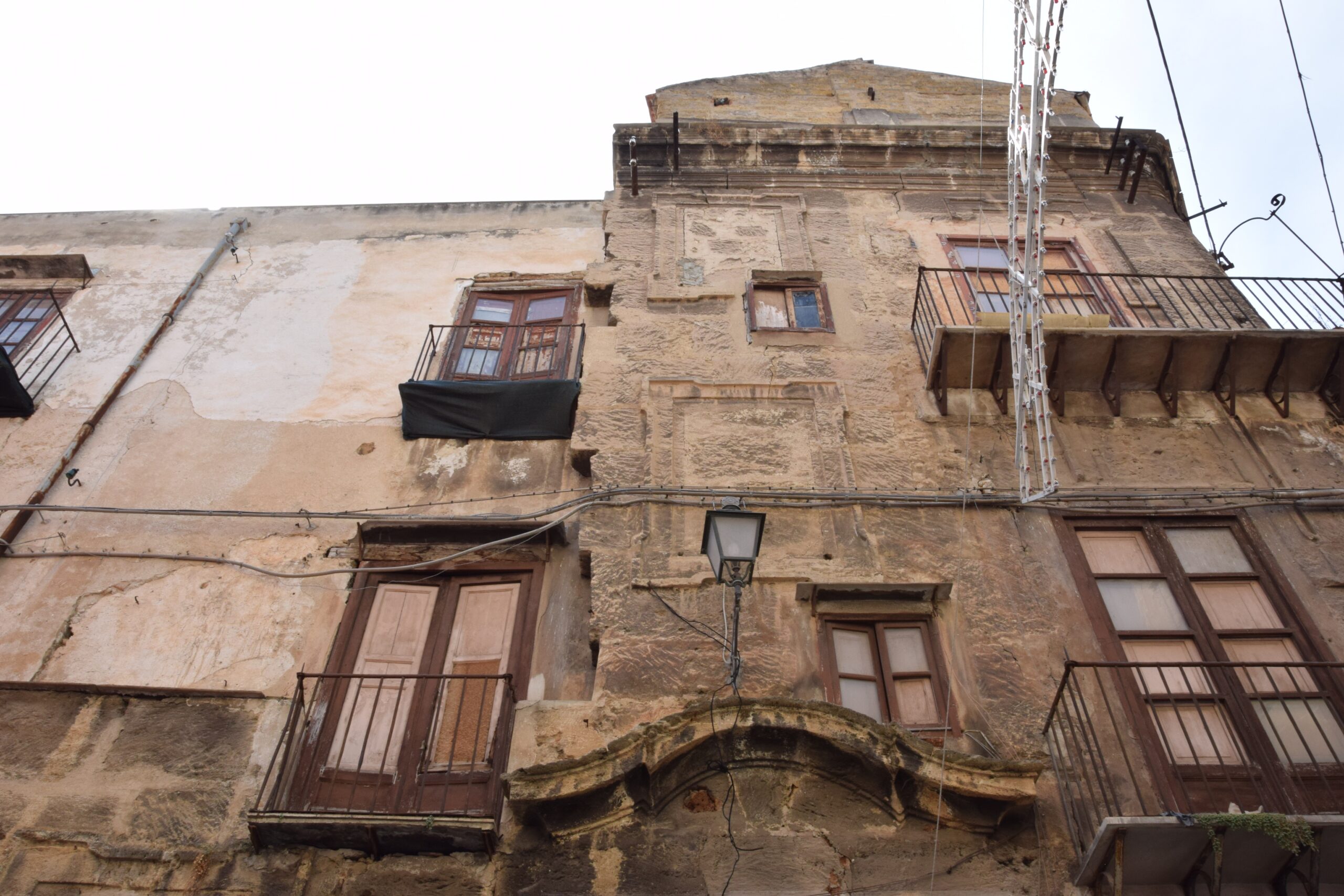
On my first full day in Palermo (now ten days ago) I stood at the edge of a huge farmers’ market, staring up at one of the buildings along the market’s labyrinth of alleys. For those of you who know me, it’s a familiar state to see me in… looking up the lines of a building, trying to figure it out.

“Quattrocento” said a voice next to me. “Is quattrocento building.” The veggie purveyor was trying to explain it to me, in one of those delightful moments of people with little common language hacking through the need to connect. Quattrocento in art means 1400 to 1499, so this building has been there 600 years or so.
Six hundred years. Oh, the changes this building has seen. How many families have lived in it? How many zucchini have been sold at its doorstep?
How many times has the latest technology been added to it? I identified electricity and television cables, and pipes for water. No doubt the cell tower is close by and the satellite dish is on the back. Wooden doors have been replaced, iron balconies have been updated. And yet… six hundred years. There was no need to tear it down, just a need to make it work for NOW, whenever that NOW happened to be.
And making it work here doesn’t demand a beautiful solution, although they exist, just a functional one. Don’t need that window anymore? Fill it in. Need a new one in a different place? Cut the hole for it. The pediment no longer protects a door? No matter… leave it be, it’s not hurting anything.
I think the story here is that there is the adaptation of Italy, but only as much as it needs to. We don’t change Italy much, but Italy can change us, especially if we let it.
Every hill town I’ve been in this week is full of roads that will barely hold a car. So guess what? The cars here are small, no bigger than they need to be to navigate their roads, yet fast enough for their modern motorways. Yes, we drove down the one below, and barely squeaked through.

Better yet, if you don’t need a car, you can zip around pretty much anything on a motorbike, and yep, those are small too. They’re not 1000cc rockets, but nimble Vespas that can be ridden in a skirt and heels if needed.

Stores are small too; they carry what you need for a few days, and not much more because, let’s be honest here, who would want to carry that home? Some of the stores were so small the space was filled and the owner sat outside on a chair.
As a visitor, all this feels so very quaint. After the opulence of my American life, I would imagine these small confines might wear on me after a while though, and make me long for the luxury of the hot food section of my local Whole Foods.
Yet I can’t help but ponder if I ought to be looking at the philosophies that drive the Italian hill town life. People greet each other with unselfconscious affection; our guide and her sweet toddler were stopped endlessly as we walked the local streets for a quick kiss-to-the-cheeks and a few rapid fire words of catching up on the news. Every meal was an opportunity to slow down and really savor the food; there is very little take-out here, and even less eating on the go. Dinner is a drawn-out affair of wine and pasta and conversation and coffee and cannoli or gelato, with no hovering waiter to rush you off the table; if the restaurant is full, it’s full, and you go elsewhere.
What would my life look like if I ate more slowly with friends? Or at least not over the sink?! What would it look like if I hugged my friends with wild abandon when I see them, not giving a damn about how that looks to the strangers around us? What would our world look like with smaller cars, and a few streets that weren’t wide enough for the big ones?
Yes, the inconvenience might slow us down. But I think that might not be a bad thing.
The Embroidered Journey is an artistic destination travel experience! Learn more about our tours!
Leave A Comment